

This article is written in Malay first and then expanded into the English version.
MALAY
Pagi tadi terbuat satu benda bodoh sikit, scroll komen Facebook. Biasalah, topik sekolah vernakular. Ada yang kata sekolah Cina patut dimansuhkan demi “perpaduan negara”.
Dalam satu thread, saya terbaca komen ni. Komen perkauman, tapi dibungkus elok-elok dengan alasan sejarah dan “kesyukuran”:
> “kalau melayu x sincere dah kena hantar balik dah bangsa u. y sentuh isu bangsa agama dan hak bumiputera semu dr bangsa u dulu. kalau korang x sentuh sensitiviti bangsa melayu dan agama islam, kitaorang x kecoh la.”
Maksud dia senang saja. Kalau orang Melayu tak ikhlas, kami dah lama “dihantar balik”. Katanya kami yang mula sentuh isu bangsa, agama, hak Bumiputera. Kalau kami diam, mereka pun tak bising.
Lepas tu dia tambah lagi:
> “sila bersyukur orang melayu tolong bangsa ko masa kena kejar dengan jepun dan komunis… sila bersyukur orang melayu terima bangsa ko masa british tak nak hantar korang balik cina.”
Saya baca semua ni dan bukan marah. Saya dah lama lepas fasa marah. Yang tinggal cuma rasa kosong.
Tapi hakikatnya, saya rakyat Malaysia. Keluarga saya dah ada di sini berpuluh-puluh tahun. Saya cakap dan tulis Bahasa Melayu dengan ok-ok. Saya pergi sekolah kebangsaan. Saya sertai Khidmat Negara. Saya mengundi. Saya bayar cukai. IC saya sama macam orang lain. Pasport saya sama macam Perdana Menteri dan Yang di-Pertuan Agong.
Tapi bagi orang macam ni, saya tetap tak cukup “Malaysia”. Saya dianggap tetamu. Orang yang patut bersyukur sebab “dibenarkan” tinggal. Orang yang boleh disuruh balik bila-bila masa kalau majoriti rasa saya tak tahu diri.
Masalahnya, nak hantar balik ke mana? Masa datuk saya datang dulu, India dan Pakistan pun belum wujud macam hari ni. Saya lahir di sini. Negara ni rumah saya. Dari dulu sampai sekarang.
Masa tu saya sedar, ini bukan isu asimilasi. Ini isu kuasa. Dan tak kira berapa banyak kita berasimilasi, ia takkan pernah cukup.
---
Dulu saya percaya pada asimilasi. Bukan asimilasi yang buang identiti sendiri, tapi hidup bersama, belajar bahasa, faham budaya, jadi sebahagian daripada masyarakat.
Saya pergi SRJKC, lepas tu SMK. Saya ada kawan Melayu, Cina, India. Raya sama-sama. Main sama-sama. Besar dalam kawasan kampung yang semua bangsa ada. Itu bagi saya asimilasi sebenar.
Saya fikir itu dah cukup. Saya fikir sistem akan berubah. Saya fikir kalau kita buat semua benda betul, kita akan diterima.
Saya silap.
Bila saya dah bekerja, menyumbang kepada ekonomi, saya fikir sekarang barulah saya betul-betul dianggap rakyat. Tapi lepas tu saya baca komen macam ni. Lepas tu saya dengar ahli politik jerit pasal “hantar balik”, “tuan rumah”, “kena bersyukur”.
Masa tu saya faham. Tak kira apa saya buat, saya akan sentiasa dianggap “orang lain”. Asimilasi bukan matlamat sebenar. Matlamat sebenar ialah kawalan. Selagi kita dianggap “lain”, senang untuk kekalkan sistem yang berat sebelah.
---
Thread tu asalnya daripada satu post oleh Aliff Ahmad, yang cakap ramai Melayu yang sekolah Cina sokong pemansuhan sekolah vernakular. Alasan dia biasa: sekolah Cina konon halang perpaduan, pelajar Cina tak pandai BM.
Saya balas ringkas. Kalau betul nak hapuskan vernakular demi kesamarataan, kenapa institusi Bumiputera eksklusif dan kuota tak disentuh? Kenapa kesamarataan hanya diminta dari satu pihak?
Jawapan yang saya dapat pun boleh agak. Ada yang kata saya tak faham Perlembagaan. Ada yang suruh saya bersyukur.
Tapi komen paling jelas ialah ayat “kalau Melayu tak ikhlas, korang dah kena hantar balik”.
Ayat tu penting. Sebab ia tunjuk cara fikir sebenar. Kononnya kewujudan kami di sini bergantung pada ihsan orang lain. Itu bukan perbahasan dasar. Itu penafian kewujudan.
Lepas tu keluar pula ayat “sila bersyukur”.
Bersyukur untuk apa? Sebab dibenarkan lahir di negara sendiri?
---
Bila orang politik cakap pasal “kontrak sosial”, ramai tak sedar benda ni sebenarnya tak wujud dalam Perlembagaan. Istilah tu mula digunakan tahun 1986 oleh ahli politik UMNO, lama lepas merdeka. Ia tak ada dalam Laporan Suruhanjaya Reid. Ia tak ditulis dalam mana-mana undang-undang.
Perkara 153 memang wujud. Tapi ia bukan lesen untuk diskriminasi tanpa had.
Perkara 153 jelas sebut:
* Kedudukan istimewa Melayu dan kepentingan sah kaum lain mesti dilindungi.
* Hak sedia ada tak boleh dilucutkan.
* Layanan sama rata dalam perkhidmatan awam masih terpakai.
* Tak boleh sekat perniagaan orang lain semata-mata atas nama kuota.
Masalahnya, ahli politik hanya petik bahagian yang untungkan mereka. Klausa imbangan sengaja diabaikan.
Kerakyatan pula bukan hadiah. Ia hak yang dijamin Perlembagaan. Jus soli. Automatik. Bukan sebab belas kasihan sesiapa.
---
Bila saya tengok data, naratif mereka terus runtuh.
20% pelajar sekolah Cina bukan Cina. Melayu, India, Orang Asli. Mereka pilih sebab kualiti pendidikan.
Bukan Melayu fasih BM. Digunakan setiap hari, bukan dipaksa.
Kami adalah warganegara negara ini sepenuhnya. Mengundi, bayar cukai, berkhidmat.
Tapi kami masih dikecualikan secara sistematik. Kuota, institusi eksklusif, perkhidmatan awam.
Jadi jelas. Masalahnya bukan kami tak berasimilasi. Kami dah buat semua yang diminta. Tapi matlamat sebenar bukan asimilasi. Matlamatnya ialah kekalkan hierarki.
---
Hari ini, saya dah berhenti cuba buktikan saya “cukup Malaysia”. Saya dah lama rakyat Malaysia. Saya tak perlu mohon pengiktirafan. Saya tak perlu bersyukur untuk hak yang memang milik saya.
Saya masih cakap Bahasa Melayu. Saya masih hormat budaya. Tapi saya buat semua tu sebagai rakyat, bukan tetamu.
Dan perubahan tu penting. Sebab bila kita sedar kita memang tergolong, retorik “hantar balik” hilang kuasa.
Soalan sebenar bukan “bukan Melayu dah berasimilasi atau belum”.
Soalan sebenar ialah:
Bila kalian akan terima hakikat yang kami dah lama berasimilasi?
Kami dah buat bahagian kami.
Masalahnya bukan kami.
Masalahnya ialah sistem dan mentaliti yang masih nak kami jadi tetamu dalam negara sendiri.
Kami rakyat Malaysia. Kami sentiasa rakyat Malaysia. Dan kami tak akan ke mana-mana.
Harinder Singh, ini Negaraku, tanah tumpahnya darahku.
- ENGLISH VERSION
I was scrolling through Facebook comments at 2AM, which is already a bad life choice. But there I was, reading a thread about vernacular schools, watching people argue about whether Chinese schools should be abolished for “national unity.”
And then I saw it. A comment from someone, responding to another user’s point about quotas and fairness. The comment was a masterpiece of casual racism, wrapped in the language of gratitude and history:
“kalau melayu x sincere dah kena hantar balik dah bangsa u. y sentuh isu bangsa agama dan hak bumiputera semu dr bangsa u dulu. kalau korang x sentuh sensitiviti bangsa melayu dan agama islam, kitaorang x kecoh la.”
Translation: “If Malays weren’t sincere, you would have been sent back already. You started all the issues about race, religion, and Bumiputera rights. If you didn’t touch on Malay and Islamic sensitivities, we wouldn’t be making noise.”
And then, the kicker: “sila bersyukur orang melayu tolong bangsa ko masa kena kejar dengan jepun dan komunis, sila bersyukur orang melayu terima bangsa ko masa british tak nak hantar korang balik cina.”
“Please be grateful that Malays helped your race when you were chased by the Japanese and communists. Please be grateful that Malays accepted your race when the British didn’t want to send you back to China.”
I read that, and something broke in me. Not anger, I was past anger. Something colder. Something more final.
Because here is the thing: I am Malaysian. My family has been here for generations. I speak and write Bahasa Malaysia fluently, with all its dialects. I speak and write English, Mandarin, Punjabi, and I also speak Urdu and Cantonese and a little bit of Japanese and Korean. My IC is of the same color as the Prime Ministers’ and Yang di-Pertuan Agong’s. My passport is the same as everyone’s. I went to national schools. I participated in national service. I vote. I pay taxes. I contribute. I am as Malaysian as anyone else.
But according to this person, and according to the politicians who use this rhetoric, I am not Malaysian enough. I am a guest. I am someone who should be “grateful” for being allowed to stay. I am someone who could be “sent back” if the majority decides I am not grateful enough.
When my grandfather came, it was not India or Pakistan, those countries did not exist yet. So I do not know where to send me to. Back to Malaysia? I am already here. This is my country. This has always been my country.
That is when I realized: this is not about assimilation. This is not about unity. This is about power. And no matter how much we assimilate, it will never be enough.
---
I used to believe in assimilation. Not the kind where you erase yourself, but the kind where you participate, integrate, become part of the national fabric. I thought if we just did enough, learned the language, participated in the culture, contributed to society, we would be accepted.
I was wrong.
I went to SRJKC (Sekolah Rendah Jenis Kebangsaan China) and then SMK (Sekolah Menengah Kebangsaan). I learned Bahasa Melayu, English, and my mother tongue. I participated in school activities, made friends across ethnic lines, celebrated Hari Raya with my Malay friends, attended Chinese New Year with my Chinese friends.
I grew up in the same rumah setinggan kampung with other Malays, Indians, Chinese, and lain-lain. We played together, ate together, celebrated together. We were neighbors. We were friends. We were Malaysian. That is what assimilation actually looks like, not erasing yourself, but living together, sharing space, building community.
I thought that was assimilation. I thought that was enough. I thought, okay, maybe this is temporary. Maybe the system will change. Maybe if I just work harder, if I just prove myself, it will be different.
I was wrong.
I got a job, started contributing to the economy. I thought, now I am Malaysian. Now I have earned it. Now I belong.
Then I read comments like other Malaysian. Then I saw politicians calling for vernacular schools to be abolished. Then I heard the rhetoric: “hantar balik,” “tuan rumah,” “bersyukur.” Then I realized: no matter what I do, no matter how much I assimilate, I will always be “other.” I will always be a guest. I will always be someone who should be grateful for being allowed to stay.
That is when I understood: assimilation was never the goal. Control was. And you cannot control people who have already assimilated. You need them to remain “other” so you can justify the system that keeps you in power.
---
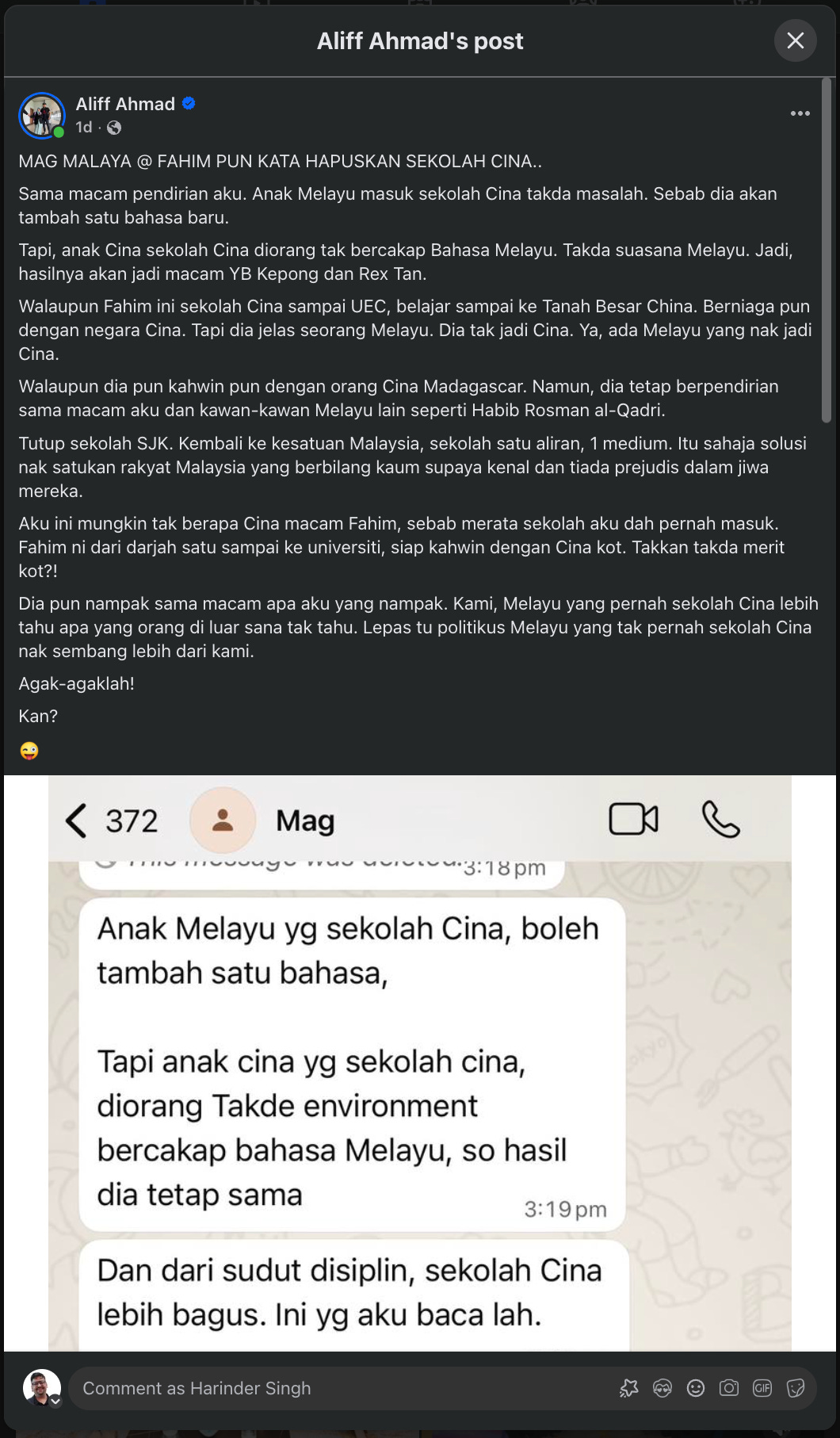
The Facebook thread started with a post by Aliff Ahmad(possibly a cytro), talking about how MagMalaya (a Malay influencer who went to Chinese school) supports abolishing vernacular schools. The argument was familiar: Chinese schools prevent unity, Chinese students do not speak Bahasa Melayu, we need one school system for all.
I commented, as I often do, pointing out the hypocrisy: if we are going to abolish vernacular schools, why not abolish exclusive Bumiputera institutions too? Why not remove quotas? Why not make education truly equal?
The responses were predictable. Someone said I did not understand the Constitution. Someone said I was questioning Bumiputera rights. Someone said I should be grateful.
But it was Iffa Fadhil’s comment that hit different. Because it was not just about policy. It was not just about education. It was about belonging. It was about whether I, and people like me, actually belong here.
“kalau melayu x sincere dah kena hantar balik dah bangsa u.”
“If Malays weren’t sincere, you would have been sent back already.”
That line. That assumption that we are here on sufferance, that we could be “sent back” at any moment, that our presence is conditional on the majority’s “sincerity.” That is not policy debate. That is erasure. That is telling someone they do not belong, no matter how long they have been here, no matter how much they have contributed, no matter how Malaysian they are.
And then: “sila bersyukur.”
“Please be grateful.”
Grateful for what? For being allowed to exist? For being allowed to stay in the country where I was born? For being allowed to be Malaysian?
That is when I realized: this is not about what we have done or not done. This is about what they think we owe them. And what they think we owe them is everything. Our identity, our culture, our language, our history, our right to exist as anything other than grateful guests.
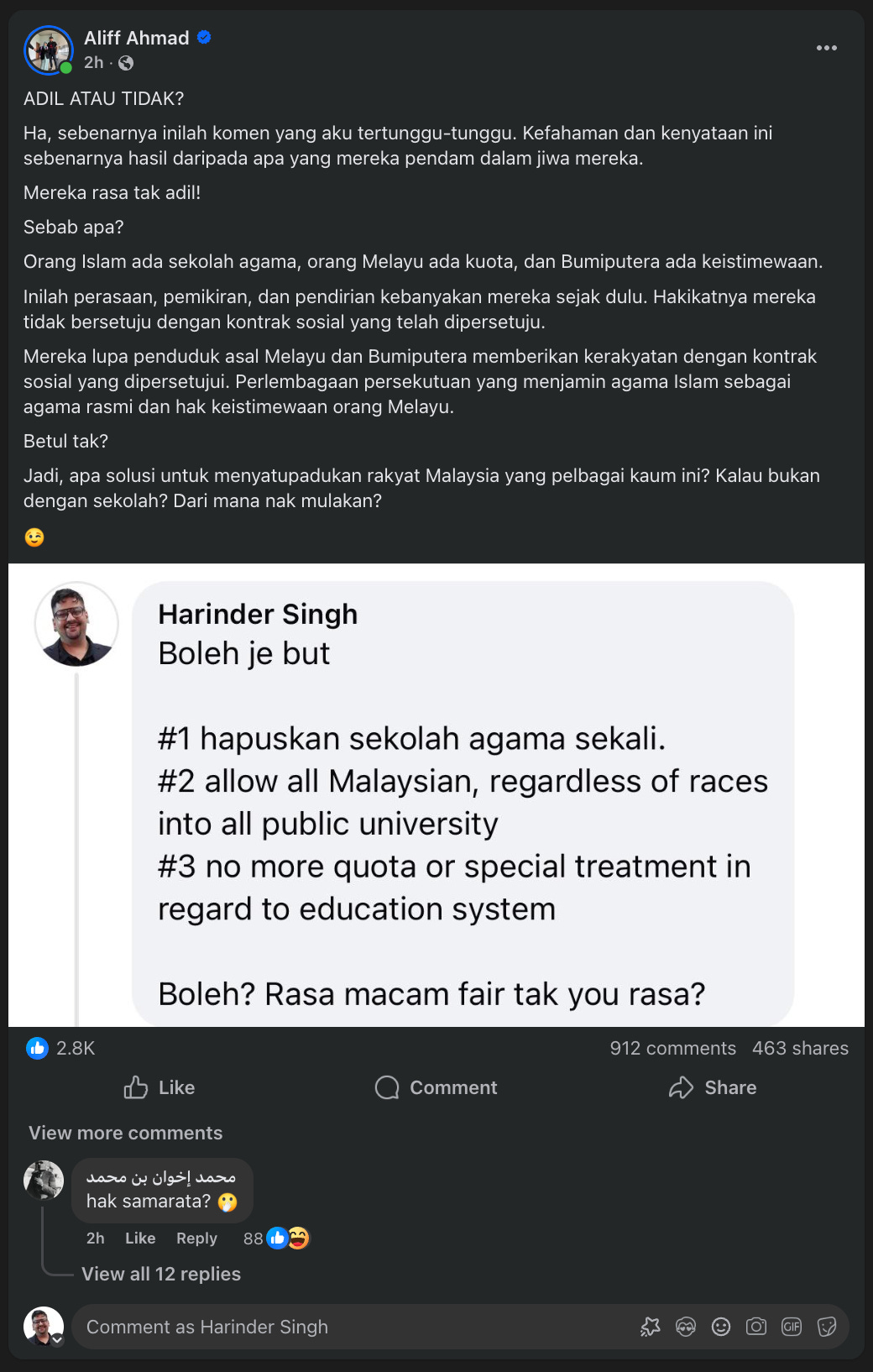
It did not end in that thread. Aliff took my comment and made a new post. “ADIL ATAU TIDAK?” He wrote that this was the comment he had been waiting for; that it revealed what “they” have been hiding in their hearts; that “they” feel it is unfair; that “they” do not agree with the social contract; that “they” forget the original Malays “gave” citizenship. The replies: “Hantar pulang.” “Balik tempat asal korang dulu, baru deal.” “Ibarat ko masuk rumah org.” “Tambi bodo.” “Kena halau balik.” “Kaduk naik junjung.” Hundreds of them. My ask was reciprocity, if we remove vernacular, remove religious and quota too. The response was to reframe it as proof that we reject the deal, and to invite the “hantar balik” that was always waiting. No engagement with the logic. When you point out the double standard, your words are taken, twisted, and used to rally the very script you were criticizing.
But here is what they do not tell you: the “social contract” they keep invoking? It does not exist in the Constitution. It is not written anywhere. It is a political narrative, first used in 1986 by UMNO politician Abdullah Ahmad, nearly 30 years after independence. It is not in the Reid Commission Report. It is not in the Constitution. It is a story. A convenient story. A story that gets told to justify inequality without having to admit it is about power.
The Constitution contains Article 153, which deals with the “special position” of Malays and Bumiputera. Here is what Article 153 actually says:
Article 153(1) - gives the Yang di-Pertuan Agong the responsibility to “safeguard the special position of the Malays and natives of any of the States of Sabah and Sarawak” and to ensure “reasonable” reservations in public service, scholarships, and business licenses.
Article 153(2) requires the YDPA Agong to exercise these functions in a manner that safeguards the special position ”and the legitimate interests of other communities.”
Article 153(4) says the YDPA Agong ”shall not deprive any person of any public office held by him or of the continuance of any scholarship, exhibition or other educational or training privileges or special facilities enjoyed by him.”
Article 153(5) says “This Article does not derogate from the provisions of Article 136”, which guarantees equal treatment in public service regardless of race.
Article 153(8) says that while reservations may be made, ”no such law shall... deprive or authorize the deprivation of any person of any right, privilege, permit or license accrued to or enjoyed or held by him.”
Article 153(9) says “Nothing in this Article shall empower Parliament to restrict business or trade solely for the purpose of reservations.”
But Article 153 does not mention a “social contract.” It does not say citizenship was “given” in exchange for accepting special rights. It does not say non-Malays agreed to permanent inequality. It does not say the special position is absolute or unlimited. It says the special position must be balanced with the “legitimate interests of other communities.” It says existing rights cannot be deprived. It says equal treatment still applies.
That is what Article 153 actually says. The “social contract” narrative is a political story, retroactively applied, used to shut down questions and justify policies that were never part of any original agreement.
When politicians say “they reject the social contract,” what they mean is: “they question policies that favor us.” When they say “they forget we gave them citizenship,” what they mean is: “they forget their place.” But citizenship by birth (jus soli) is a right, not a gift. It is guaranteed by the Constitution. It is automatic. It is yours by right, not by sufferance.
---
The slap came not only from the Facebook comment, or from the new post that weaponized it, but from what happened when I started researching. I wanted to know: have we actually assimilated? What does the data say? And what is this “social contract” they keep invoking?
What I found destroyed both narratives:
20% of Chinese school students are not Chinese. They are Malay, Indian, Orang Asli, foreign. They are choosing Chinese schools not for cultural reasons, but because the education is better. This is assimilation in action, non-Chinese participating in Chinese schools, learning Mandarin, integrating.
Non-Malays speak Bahasa Melayu fluently. Reddit discussions, academic studies, everyday reality all show the same thing: non-Malays learn Malay, use it daily, default to it in mixed-race interactions. The claim that we “reject” Malay is provably false.
We participate in national life. We vote, pay taxes, serve, contribute. We celebrate national holidays, respect national symbols, believe in one national identity. We are as Malaysian as anyone else.
But we are systematically excluded. 90% matriculation quota for Bumiputera. 81.9% of public university enrollment is Bumiputera. Only 5.4% of civil servants are Chinese. Exclusive Bumiputera institutions everywhere, while vernacular schools are called “divisive.”
The “social contract” does not exist. Legal experts, constitutional scholars, and the Malaysian Bar have all confirmed: there is no “social contract” written in the Constitution. The term was first used in 1986 by UMNO politician Abdullah Ahmad, nearly 30 years after independence. It is not in the Reid Commission Report. It is not in the Constitution. It is a political narrative, retroactively applied, used to justify policies that were never part of any original agreement. ([malaysianbar.org.my], [thestar.com.my])
Article 153 was meant to be temporary. The Reid Commission, which drafted the Constitution, recommended that Article 153 be reviewed within 15 years of independence, with the intention that special privileges should eventually be reduced as Malays gained parity. That review never happened. After 70 years, the “temporary” measure has become permanent. ([en.wikipedia.org])
Article 153 has balancing clauses. It has 10 clauses, not 3. The clauses that get ignored, clauses 4, 5, 7, 8, 9, are the ones that matter. They say the special position must be balanced with the “legitimate interests of other communities.” They say existing rights cannot be deprived. They say Article 136 (equal treatment in public service) still applies. But politicians only quote the first 3 clauses. They do not want you to see the balancing clauses. ([en.wikipedia.org])
That is when it hit me: we have assimilated. We have done everything they asked. We speak their language, participate in their culture, integrate into their society. And the “social contract” they keep invoking to justify exclusion? It does not exist. It is a political tool. A narrative. A story. And it is still not enough.
Because this is not about assimilation. This is about maintaining a hierarchy. This is about keeping non-Malays in a position where they can never be “Malaysian enough,” no matter what they do.
The goalposts keep moving. First it was “learn Malay.” We did. Then it was “participate in culture.” We did. Then it was “abandon your schools.” We integrated them instead. Then it was “be grateful.” We are, but not in the way they want.
The truth is: there is no amount of assimilation that will be enough. Because the goal is not assimilation. The goal is control. And you cannot control people who have already assimilated. You need them to remain “other.”
---
Here is what changed: I stopped trying to prove I was Malaysian enough. I stopped trying to assimilate in ways that required erasing myself. I stopped believing that if I just did enough, if I just proved myself, I would be accepted.
Because I realized: I am already Malaysian. I do not need to prove it. I do not need to earn it. I do not need to be grateful for it. I was born here. My family has been here for generations. I am as Malaysian as anyone else.
That does not mean I stopped participating. I still speak Bahasa Melayu. I still celebrate Hari Raya. I still participate in national life. But I do it as a Malaysian, not as a guest trying to earn my place.
And here is the thing: that shift, from “trying to earn belonging” to “knowing I already belong,” that changes everything. It changes how you engage with the rhetoric. It changes how you respond to the “hantar balik” comments. It changes how you see yourself.
You stop asking “What more do they want from me?” and start asking “Why do they think they can demand this from me?”
You stop trying to prove you are Malaysian enough and start demanding to be treated as Malaysian.
You stop being grateful for being allowed to exist and start insisting on your right to exist.
That is the messy middle. It is not clean. It is not comfortable. It is full of contradictions. You are still Malaysian. You still participate. You still contribute. But you are no longer trying to earn what you already have.
---
The realization I had, reading that Facebook comment at 2AM, is not just personal. It is structural. It is about how power works, how narratives are constructed, how systems maintain themselves.
The narrative that “non-Malays have not assimilated” is not true. But it does not need to be true. It just needs to work. And it works because it justifies everything: the quotas, the exclusive institutions, the special rights, the rhetoric of “gratitude” and “belonging.”
The “social contract” they keep invoking? It does not exist. It is not in the Constitution. It is not in any legal document. It is a political narrative, first used in 1986, nearly 30 years after independence. It is a story. A convenient story. A story that gets told to justify inequality without having to admit it is about power.
When politicians say “they reject the social contract,” what they mean is: “they question policies that favor us.” When they say “they forget we gave them citizenship,” what they mean is: “they forget their place.” But citizenship by birth is a right, not a gift. It is guaranteed by the Constitution. It is automatic. It is yours by right.
Article 153 exists. It is legal. But it was meant to be temporary. The Reid Commission recommended review after 15 years. That review never happened. After 70 years, the “temporary” measure has become permanent. And Article 153 has balancing clauses, 10 clauses, not 3. The clauses that get ignored are the ones that matter. They say the special position must be balanced with the “legitimate interests of other communities.” But politicians only quote the first 3 clauses. They do not want you to see the balancing clauses.
So here is what I want you to understand: we have assimilated. We speak your language. We participate in your culture. We integrate into your society. We are Malaysian. And the “social contract” you keep invoking to justify exclusion? It does not exist. It is a political tool. A narrative. A story. And we are done believing in stories that are used to justify our exclusion.
And if that is still not enough, if you still demand more, if you still tell us we do not belong, then the problem is not us. The problem is you. The problem is a system that demands assimilation while preventing it. The problem is a narrative that says we are guests in our own country.
We are not going anywhere. We are not going to erase ourselves. We are not going to be grateful for being allowed to exist.
We are Malaysian. We have always been Malaysian. And we are done trying to prove it.
The question is not “Have non-Malays assimilated?” The question is “When will you accept that we have?”
Because until you do, until you stop using “assimilation” as an excuse for discrimination, until you stop telling us we do not belong, this country will remain divided. Not because we have not assimilated, but because you refuse to see that we have.
We have done our part. Now it is your turn.
Harinder Singh, ini Negaraku, tanah tumpahnya darahku.