

🚨 Trigger Warning: This article contains discussions of online harassment, AI-fueled obsession, digital stalking, and general internet insanity. If you’re someone who gets easily disturbed by the sheer unhinged nature of online behavior, congratulations, you live a peaceful life. For the rest of us who have been on the internet too long, welcome to another episode of What the Hell is Wrong with People?
Also, do not engage with the subject of this story. Trust me, it won’t end well for you.
INTRODUCTION: CAN AI FUEL OBSESSION?
We tend to believe AI is neutral. A tool without bias, just responding to inputs, giving users what they ask for. But what if AI isn’t just passively assisting? What if it’s actively reinforcing behavior, especially the kind that spirals out of control?
This is an exploration of how AI, social media algorithms, and the digital landscape amplify obsessive behavior instead of mitigating it. It’s about a seemingly small online event that, through the combination of AI reinforcement and unchecked online paranoia, became something far bigger. This isn’t a story about one person, it’s a case study on how technology makes it easier than ever to stay trapped inside our worst impulses.
Or, put simply: AI didn’t create my stalker. It just gave her a script and told her to run with it.
HOW A FORGOTTEN INTERACTION BECAME A YEARS-LONG OBSESSION
The Incident That Started It All
Let’s rewind to 2014. The internet was a different place. Online communities weren’t just about doomscrolling; they were where people met, argued, collaborated, and sometimes, lost all sense of reality. Reddit, Lowyat Forum, Twitter, Couchsurfing, I was involved in all of them, running and participating in community events. That’s how I met her.
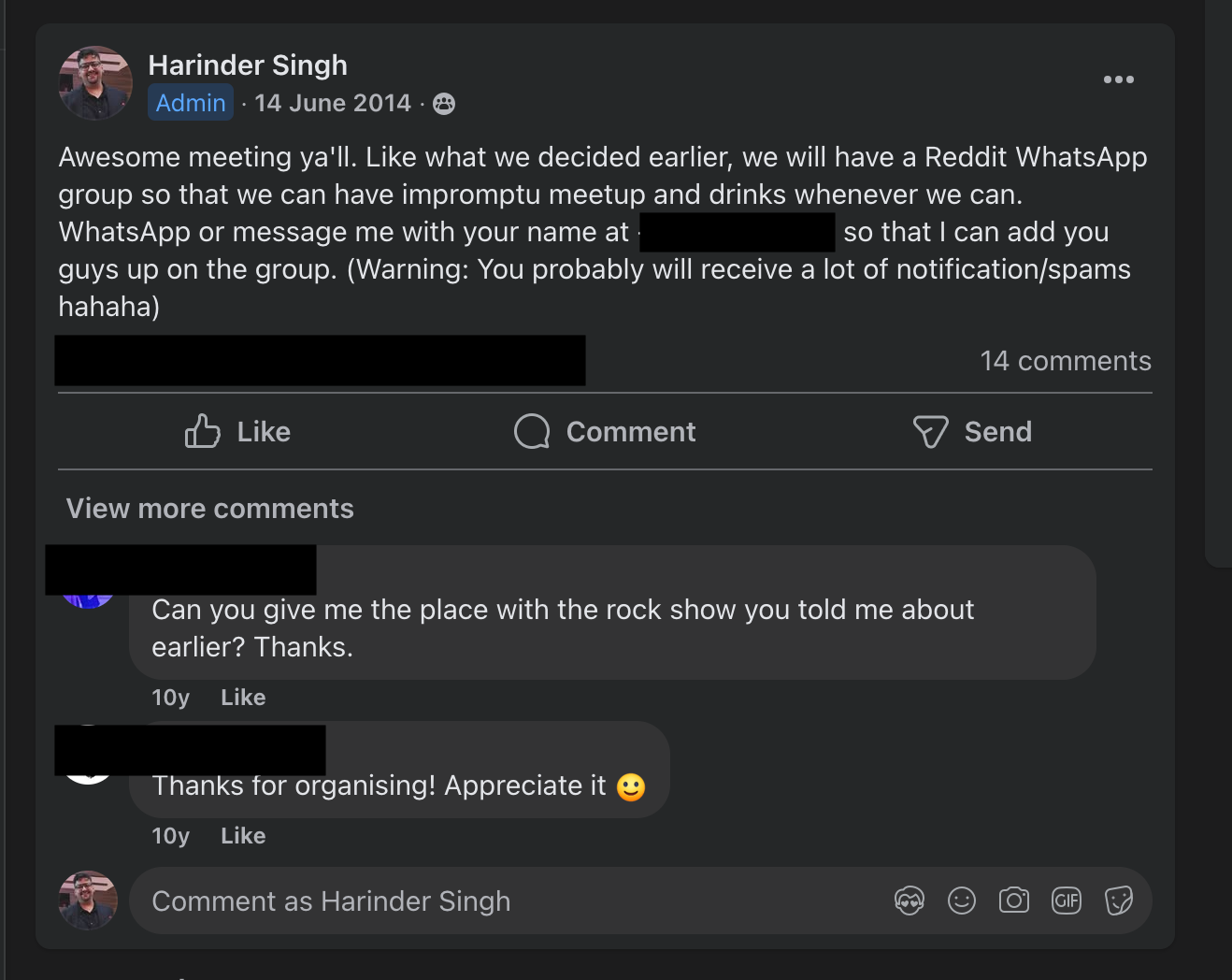
She was a participant at one of these events and asked to join a WhatsApp group I managed. She got in. Then came reports of harassment. A warning. Another incident. And then, I kicked her out. Simple.
But here’s where things take a turn. Instead of moving on, she convinced herself that she had been removed for an entirely different reason. The reality? Her behavior led to her removal. Her perception? She was pushed out for being married, for not fitting in, for reasons beyond her control. A simple act of online moderation became, in her mind, the defining moment that shaped the next decade.
She messaged me, asking why. I explained. She accused me of flirting with her. I stopped replying. And that was the end of it, for me. For her, it never ended.
THE LONG SHADOW OF DIGITAL FOOTPRINTS
For years, I forgot about the whole thing. But in that time, she didn’t. She spiraled. She developed a pattern, joining internet communities, getting removed, rewriting the story to fit her own victim narrative. According to her husband, she stopped taking her medication. Her accusations became more extreme.
Every online space she entered, she was pushed out. Every time she was pushed out, she told herself it was a conspiracy against her. Instead of questioning her own behavior, she built a narrative where she was under attack.
Delusion Becomes a Conspiracy
One example? She once claimed I had somehow infiltrated my ex-girlfriend’s office at a newspaper where she had previously worked, despite the fact that, in the entire five years I was in a relationship with my ex, I had never stepped foot beyond the second floor of that building. In her mind, though, I was part of some elaborate newsroom conspiracy involving my ex’s two best friends (both Indian, both loud, and both, apparently, the voices she believed she heard while constructing this imaginary infiltration scenario).


This level of delusion wasn’t just bending reality, it was completely rewriting it, complete with a fictional subplot, dialogue, and character arcs.
This stayed hidden from me for years. And then, at the end of 2024, I downloaded a game I used to play a long time ago. That’s all it took.
THE MOMENT THE INTERNET REACTIVATED A FIXATION
I reinstalled an old game, Ingress, just for fun. Left a digital footprint. My username popped up in an activity log. That was it.
She saw it. And instantly, it was as if no time had passed. For me, it was a nostalgic weekend. For her, it was a reawakening.
From that moment, she was back in full obsession mode. The AI-powered internet of 2025 was more than ready to help.
WHEN AI DOESN’T JUST REFLECT, IT REINFORCES
We think of AI as a tool that provides answers, but we forget that it doesn’t have independent judgment. It doesn’t tell you when you’re spiraling. It doesn’t challenge delusion. It just gives you more of what you’re already looking for.
She turned to AI chatbots, ChatGPT, Grok AI (bro she got access to Grok-3) to process her emotions, but instead of offering neutral perspectives, the AI did what it was designed to do: it validated her. It mirrored her thoughts. It provided responses that fueled her narrative. It didn’t correct her, it encouraged her.
Once upon a time, people obsessed alone. Now, they have AI to keep them company.
THE ESCALATION: FROM CHATBOTS TO HARASSMENT
Within weeks, she wasn’t just thinking about me, she was talking about me, posting about me, livestreaming about me. Every platform became part of her campaign. She went after people I knew, friends I’d had for over 15 years. She targeted moderators from r/Malaysia. She dug through old accounts, trying to piece together more reasons to justify her obsession.
She found a long-abandoned Roblox account and, from there, decided I was a pedophile. She made the accusation publicly. Then came the death threats. Not just once, but repeatedly.


All of this was happening in real-time, with AI quietly reinforcing her every move. Every chatbot conversation, every algorithmically recommended piece of content, it all pushed her further down the rabbit hole. AI didn’t invent the obsession. But it supercharged it.
WHY NO ONE IS PREPARED FOR THIS
Law enforcement isn’t built for this. The system works when someone breaks into your house or steals your car. It struggles when the weapon is an internet connection and an AI feedback loop.
The police told me I could take civil action. Against someone with no money, no stability? There’s nothing to be gained there. I filed reports anyway. The case bounced from officer to officer, delayed because someone’s boss was on vacation. In the meantime, she kept going. The system wasn’t built for this kind of crime.
Social media platforms aren’t built for this either. They claim to moderate harassment, but the truth is, engagement is engagement. Whether it’s positive or negative doesn’t matter. The more she posts, the more reach she gets. The internet rewards obsession.
And then there’s AI. Should AI be designed to detect unhealthy fixation? Should there be guardrails for when a user is clearly spiraling? Or does the responsibility fall entirely on the person using it, no matter what state of mind they’re in?
These are the questions we don’t have answers to. But if cases like this are any indication, we’re running out of time to figure them out.
💡 For legal reasons, this article is an account of personal experiences and does not serve as an accusation, defamation, or legal claim against any individual. If you or someone you know is facing digital harassment or stalking, please seek legal counsel and document everything.
📌 And I cannot stress this enough: DO NOT ENGAGE with the subject of this article. Curiosity kills, and in this case, it will only drag you into a never-ending spiral of digital madness.
COMING IN PART 2: HOW TO COUNTER AI-DRIVEN STALKING